
Why Every Lean Team Needs Minimum Functional Standards
By Shane Blanchard CLMP, CLE, Director Planning & Implementation, MOCA Systems, Inc., the provider of Touchplan®
 The next time you look at your project’s planning process, ask yourself one question: If a new superintendent joined the project tomorrow, would they immediately understand how work is planned, tracked, and committed, or would someone first have to explain how “this project does it”? If the answer is the latter, your planning process may have a standardization problem.
One of Lean’s primary objectives is reducing unnecessary waste. Most teams focus on production waste, but few recognize the waste created by planning variation. When every planner names tasks differently, tracks different information, or defines readiness differently, teams spend valuable time interpreting work instead of coordinating it. Knowledge becomes tribal. Planning meetings become translation sessions. Data becomes inconsistent. Turnovers become painful.
That’s why we developed what we call Minimum Functional Standards: a common set of planning rules that ensures everyone plans work the same way.
How One Megaproject Changed the Way We Plan
Minimum Functional Standards were born out of frustration.
As our team prepared for the second phase of one of North America’s largest battery manufacturing projects, we were still grappling with the lessons of phase one. Phase one exposed a challenge that almost every large Lean project eventually encounters: The issue wasn’t commitment. It wasn’t capability. It was consistency.
Every week, 10 superintendents spent more than 120 hours across a dozen planning meetings coordinating thousands of activities. We relied on spreadsheets, disconnected planning documents, and individual approaches to describe work.
As we prepared for phase two, we interviewed more than 100 project stakeholders to identify planning friction. Repeatedly, the same pattern emerged: People weren’t struggling because they didn’t understand Lean. They struggled because everyone had a different definition of what “good planning” looked like.
That realization changed everything. Instead of asking people to become better planners, we asked, “What if every task looked the same, no matter who created it?” That was the beginning of our Minimum Functional Standards.
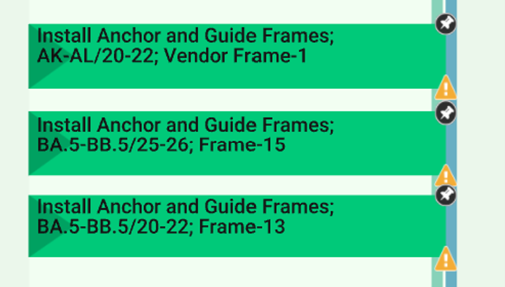
Instead of allowing every superintendent or trade partner to define work differently, we established a common planning language. Every activity followed the same structure. Every planner captured the same critical information. Every trade partner knew exactly what a complete task looked like before committing the work.
The results were dramatic. Planning meetings dropped by 70 percent, saving more than 100 hours each week. Constraint management improved. Reliable commitments increased. More than 40 trade partners aligned around a single planning system that created consistency, accountability, and trust across the project.
What we ultimately built wasn’t just a better planning process. We built a planning system that could survive turnover, scale across organizations, and improve with every project.
What Minimum Functional Standards Do and Look Like
Strong Minimum Functional Standards create tasks that anyone in the field can understand immediately. They reduce interpretation between trades, supports constraint management, survive personnel turnover, and create consistency across every phase of construction.
On our projects, every task should answer these questions instantly:
- WHAT is being worked on?
- WHERE exactly is it?
- WHO owns it?
- WHAT condition must exist before start?
- WHAT downstream work depends on it?
- IS it safe and released?
- DOES CX care?
- IS the task measurable and complete-able?
If the task cannot answer those questions quickly:
- PPC degrades
- Constraints hide
- Meetings multiply
- Recovery velocity collapses
- Schedule defensibility disappears
Five Recommendations for Deploying Minimum Functional Standards
1. Build Your Standards Around People
Don’t start with reporting requirements. Start with what a superintendent, foreman, or trade partner needs to understand within five seconds. If someone must ask what a task means, the standard isn’t complete.
2. Define the Minimum, Then Enforce It
Every task should contain the same essential information before it can be committed. Consistency is far more valuable than collecting excessive data. That’s why our deployment required planners to capture information such as ownership, manpower, materials, and safety before tasks could be saved.
3. Standardize the Language
Use consistent action types.
Use consistent location hierarchy.
Use consistent system classifications.
These may seem like small details, but they become the foundation for meaningful reporting, production analysis, and project recovery.
Good MFS Workflow Example ✅
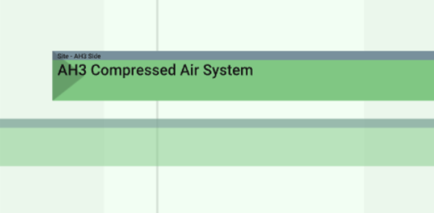
Unstructured Task Example 🚫
4. Integrate Safety and Readiness
Planning should never operate independently from safety.
The strongest Minimum Functional Standards incorporate safety requirements, permits, commissioning triggers, prerequisite work, and constraints directly into planning so teams understand not only what work is planned but whether it is truly ready to begin.
5. Choose Technology That Reinforces the Standard
Once teams share a common planning language, they’re ready to get full value from a planning platform. I recommend choosing a platform that’s intuitive and easy for everyone to use, from superintendents and foremen to trade partners. When the technology feels natural, teams can focus on planning, coordination, and execution instead of learning a complex system.
That philosophy enabled a train-the-trainer approach that allowed the system to spread rapidly across teams while maintaining consistency. Our team used Touchplan, and its ease of use made it possible for new users to get up to speed quickly while reinforcing the Minimum Functional Standards that kept every planner aligned.
Better Standards Build Better Lean Teams
Lean has never been about creating dependence on exceptional individuals. It is about creating exceptional systems. Minimum Functional Standards are one of the simplest ways to make that happen. They create clarity before work begins. They make planning scalable instead of personal. They reduce variation before it reaches the field. And perhaps most importantly, they leave behind something every successful project should strive for: a planning process that is scalable.
Continue the Conversation
Every project has unique planning challenges, but the principles behind Minimum Functional Standards are universal. If you’re exploring ways to create more consistent planning, strengthen Lean adoption, or improve coordination across your teams, I’d be happy to share what we’ve learned. Connect with me on LinkedIn or send me an email at any time.
Join me for an exclusive webinar on August 27, 2026
To learn more about minimum functional standards, register for my FREE webinar!