
Continuous Improvement Shouldn't Stop at Handover
Written by Erez Dror, VP General Contractors, Buildots
A team running the Last Planner System® well goes through the PDCA (Plan, Do, Check, Act) cycle every week. They plan the work, do it, check the result against what was promised, and adjust accordingly. The idea is, of course, to ensure continuous improvement becomes “just part of doing business” in construction.
That loop turns week after week for the length of the project.
Then the project finishes… and it stops. The team demobilizes, most of what was learned leaves the gate in people’s heads, and the next project starts by rediscovering it. LCI’s own writing on Kaizen identifies unused creativity of team members as one of the most overlooked of the eight wastes. Few places waste it more reliably than the gap between one project and the next.
Closing that gap starts with the weakest step in the cycle.
How to Take “Check” From the Project to the Portfolio Level
Within one project, a reliable Check step tells a team whether this week went to plan. Measured the same way across every project in a business, the same data answers questions no individual project can even ask:
- Which trade partners consistently deliver on their commitments?
- Is the schedule realistic, judged against what our own projects have achieved before?
- What does good look like for this activity, in this sector, in this region?
Not one of these can be answered from a single job, because a single job has no point of comparison. Until recently, it’s been extremely difficult to answer these questions at all in the construction industry. That’s because we’ve lacked a layer of standardized data from which to draw cross-project conclusions (more on this later).
To illustrate the real-world possibilities of portfolio insights, we can look at the Buildots Intelligence Lab, which publishes benchmarks built from exactly this kind of cross-project comparison.
Take this example. Analyzing 25 million square feet of global data center projects, the Lab measured MEP trades against the pace required to hit their target completion dates. HVAC systems came closest, running at 76.9% of required pace. Domestic water was furthest adrift at 44.9%, less than half the rate its own schedule assumed. Shortfalls that small in any given week compound quietly, eroding commissioning buffers long before anyone declares a delay. For a team planning the next project, that turns the question from whether a trade partner is underperforming into whether the plan was ever achievable.
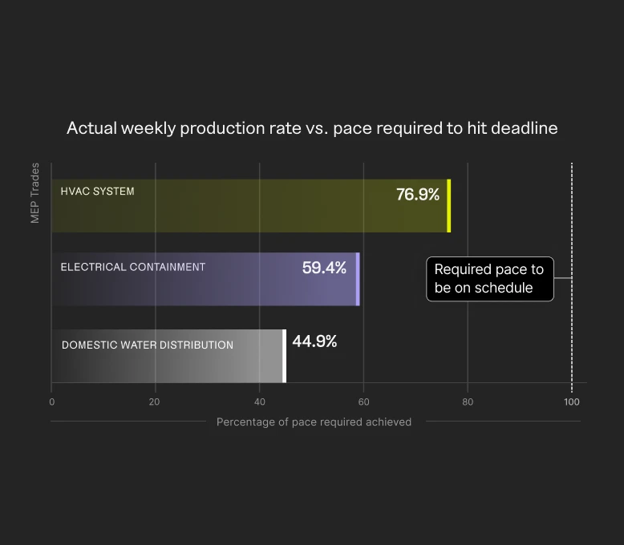
That insight is working from a wider evidence base than a single job can generate. This is LCI’s “Optimize the whole” tenet at a level where the whole is not the project, but the portfolio, or even the entire industry.
What Has to be True for Lean Construction’s “Continuous Improvement” Principle to Scale?
Most construction organizations aren’t short on data. They are, however, short of clean, verified, comparable data. Captures, PDFs, spreadsheets and one-off reports accumulate as digital exhaust, a byproduct of delivery rather than an asset.
In other words, what’s missing is data standardization.
Getting that right takes three deliberate moves:
- Measure the whole: Launch business-wide initiatives to capture and integrate construction data (schedules, BIM models, budgets, progress reports, etc.) across the entire organization, treating the portfolio as a single, measurable entity, not a collection of fragmented projects.
- Define the standard: Develop organization-wide data modeling standards that go beyond individual projects. Coordinate with tech partners to set ground rules for how data is collected, organized, and modeled across your entire portfolio.
- Build your business data strategy: Understand what data sets are crucial for business improvement, build the standard model and infrastructure to capture and manage that data at scale.
Every Project Better Than the Last
The Lean Construction community built the weekly improvement loop and made it standard practice. The opportunity now is to give it a Check step solid enough to carry real weight, and to run it over years rather than weeks. That is the difference between delivering a series of one-off jobs and building a repeatable, improvable discipline where every project starts better than the last one finished.