
Projects Don’t Struggle by Chance, they Struggle by Design
Written by Samir Emdanat, President and Co-Founder of vPlanner & Matthew Jogan, Vice President of vPlanner
Most projects don’t begin with a clear execution strategy. Not because teams don’t plan, but because the focus is placed on detailed schedules before the production system itself is designed. As a result, projects move forward with defined timelines without a shared understanding of how the work should actually flow.
The predetermined outcome is that by the time teams get serious about operational takt planning, critical decisions have already been made. Contracts are in place. Procurement strategies are locked. Capacity assumptions are baked in. The production system has already been shaped, often implicitly, through a series of early decisions that were never evaluated as part of a coherent whole.
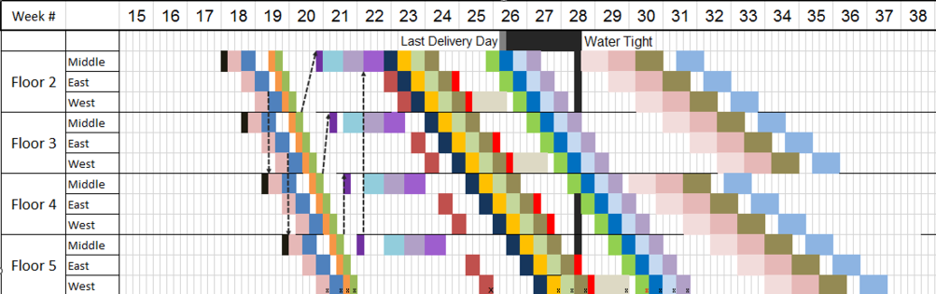
What follows is familiar. Teams spend the rest of the project managing constraints and boundaries that were unintentionally designed into the system from the start. Even when teams elect to implement takt planning at this stage, they are doing so within a set of boundaries that were never intentionally defined to support flow.
This is not a failure to plan or schedule the work. It is a consequence of when and how planning occurs. Much of the industry’s attention has focused on operational takt planning which involves aligning trades, defining zones, and developing detailed plans once projects are underway. This is work is important. It creates alignment at the level where execution actually happens, but it is inherently reactive.
Operational takt planning takes place after key decisions about contracting, procurement, and capacity have already shaped the project. By that point, the conditions that determine how work will flow, or not flow, are largely in place. The challenge is that these conditions are rarely examined in a structured way before becoming embedded into the project. They define the boundaries within which teams must operate, and, once these constraints are in place, they are difficult to unwind. If flow has not been intentionally considered at an early stage, it becomes increasingly difficult to achieve as the project moves forward.
Strategic Takt Planning
This is where strategic takt planning becomes relevant. It shifts the conversation upstream to the front end of the project, during validation and early design when the level of detail may still be limited, but the level of influence is at its highest. At an early stage, teams have the maximum ability to shape how the project will be executed, rather than inherit a set of constraints that must be managed.
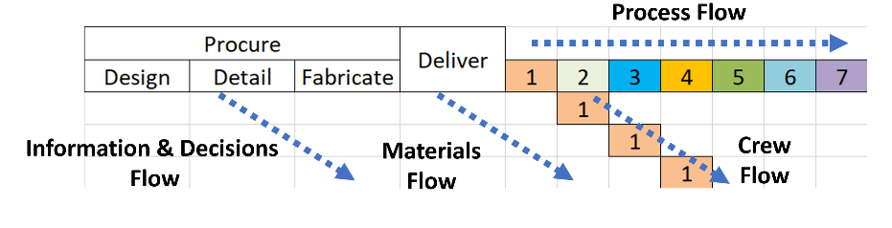
Strategic takt planning begins with demand. It asks a different question: what pace must the project achieve to meet its objectives? From that starting point, the project is structured into meaningful work phases, each with defined sequences of steps, and a target takt is calculated to align production with demand.
This is a subtle shift, but it fundamentally changes the nature of planning. It moves planning away from just listing tasks, durations, and logic ties, and toward designing a production system. Even with limited information, teams can explore alternative execution strategies and begin to understand the implications of their decisions. By adjusting variables such as zoning, sequencing, and phase structuring, teams can evaluate different pathways to completion and assess how those choices relate to cycle time, buffers, and resource requirements.
Strategic takt planning offers project teams the opportunity to test assumptions early before having contractual consequences. It also creates alignment across the project supply chain. Design decisions can be evaluated against how they affect flow. Procurement strategies can be shaped to match execution needs. Trade partners can be brought into the process with a clearer understanding of expectations around capacity, sequencing, and coordination. The production system begins to take shape as an intentional design, rather than an emergent outcome.
When this work is done early, the downstream effects are significant. Procurement aligns with execution strategy. Trade partners commit with clarity around how the work will be performed. Buffers are incorporated intentionally, rather than discovered too late. Perhaps most importantly, unrealistic schedules are identified before they become commitments that teams feel obligated to defend.
When it is not done, the consequences are equally clear. Projects move forward based on assumptions that have not been tested against production reality. Teams commit to timelines that require an unachievable pace. Constraints emerge during execution, often framed as surprises, even though they are the natural result of prior decisions. The outcome is predictable: delays, rework, and missed expectations.
Real-world applications reinforce this pattern. In our experience, strategic takt analysis has led teams to recognize when projects could not meet required timelines, prompting difficult but necessary decisions before significant commitments were made. In other cases, it has informed adjustments to design and resource allocation that enabled projects to meet critical delivery milestones. At the same time, there are examples where the analysis was dismissed in favor of more familiar scheduling methods, only for those projects to ultimately miss their targets.
Experience plays a role in how teams respond to this. Organizations new to takt planning often gravitate back to traditional approaches because they feel more comfortable, even when the data suggests an alternative. Over time, however, as teams gain more experience with takt planning a different response emerges. The advantage is not just in executing takt plans effectively. It is in starting the production execution strategy thinking earlier, when it can influence the design of the production system itself.
Strategic and operational takt planning are not competing ideas. They are complementary. Strategic takt planning defines how the project is intended to flow. Operational takt planning brings that strategy to life through validation, detailed collaboration, commitment, and execution. When they are aligned, projects are structured for flow from the outset. When they are not, teams spend much of the project trying to recover a schedule that was never designed to perform well from the start.
The industry has made meaningful progress in how it coordinates work at the operational level. The next step is to extend that thinking upstream. To accomplish this, the industry must recognize that schedules alone are not sufficient. Without a coherent execution strategy, a schedule is just a timeline applied to a system that may or may not be capable of delivering it.
To learn more about strategic takt planning, take a look at this recent IGLC paper written by Iris Tommelein (@P2SL) and Samir Emdanat (@vPlanner).
You can also visit the research page of the vPlanner website for additional references.
If you are attending the upcoming LCI Congress in Atlanta, make sure to sign up for the full day takt planning workshop offered by Samir Emdanat (vPlanner), Matthew Jogan (vPlanner), and Iris Tommelein (P2SL).